
What Is Product Development? A Complete Guide
Product development is the process of taking an idea from first concept to a working product that real users rely on, then keeping that product reliable and relevant after launch. It brings together business analysis, design, engineering, and quality control in one connected effort.
This guide explains what product development means, what it includes, how the process works, and how it differs from software development and product design. It is written for founders, product managers, and business leaders who are planning a digital product and want a clear view of the work involved.
What Is Product Development?
Product development is the end to end process of turning an idea into a product that people can use and a business can sustain. It covers research, planning, design, building, testing, launch, and ongoing improvement. In software, it also includes the maintenance that keeps a product reliable and relevant after release.
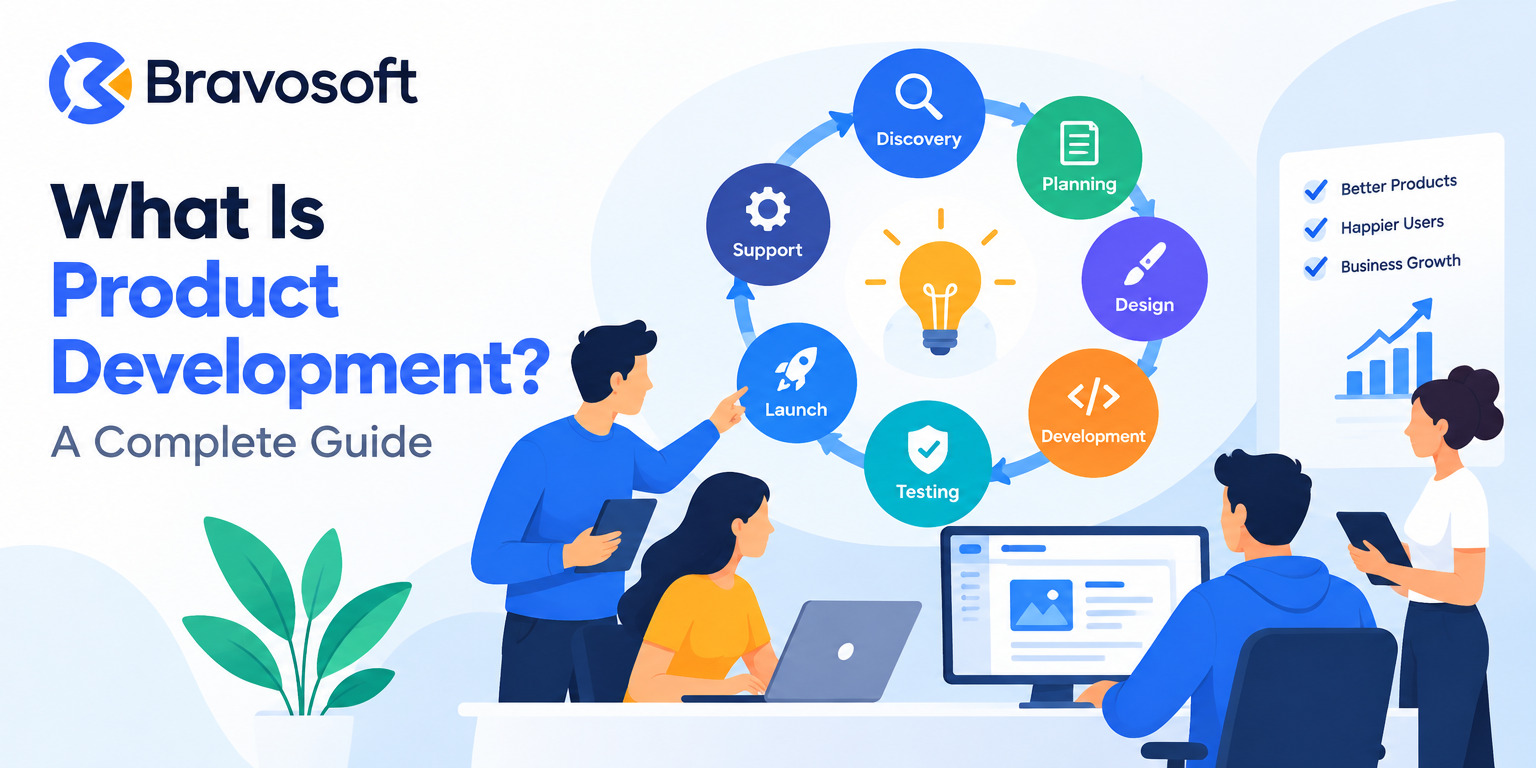
The core flow looks like this: discovery, planning, design, development, testing, launch, and ongoing support. Each stage produces something the next stage depends on, such as validated requirements, approved designs, or a tested release.
Product development is broader than building. A product succeeds only when it solves a real problem, is easy to use, and works reliably. It is also a cycle rather than a single project, because most products keep changing as the team learns from users and the market.
This guide focuses on digital product development, which covers software products such as web applications, mobile apps, and SaaS platforms. For another view of how the life cycle is framed, see Atlassian’s overview of the product development life cycle.
What Does Product Development Include?
Product development includes four groups of activity: business, design, technical, and post launch work.
- Business activities: market and user research, business analysis, goal setting, budgeting, and roadmap planning.
- Design activities: user research, wireframes, interface design, prototypes, and usability testing.
- Technical activities: solution architecture, front end and back end development, integrations, APIs, cloud infrastructure, security, testing, and deployment.
- Post launch activities: monitoring, bug fixing, user support, analytics, new features, and scaling.
Consider an online ordering platform for restaurants. The business side decides which restaurants to serve first and which problem to solve before any other. Design maps how a customer places an order and how staff manage it. Engineering builds the ordering flow, payment integration, and admin dashboard. After launch, the team studies how people actually order and fixes whatever slows them down.
Why Is Product Development Important?
Product development matters because it reduces the risk of building the wrong thing and gives teams a repeatable way to build the right thing well.
- Lower risk: research and validation happen before the largest costs are committed.
- Shared direction: business, design, and engineering work toward the same goals and measures.
- Better quality: planned testing and design review catch problems before users do.
- Cost control: fixing a misunderstanding in a wireframe is generally cheaper than fixing it in finished code.
- Room to grow: early architecture decisions determine whether a product can handle more users and features later.
What Are the Main Stages of Product Development?
The main stages of product development are discovery, research, business analysis, planning, design, prototyping, development, testing, launch, and post launch improvement. Published frameworks vary. Some list five stages and others list seven or more, and the names change by industry. The ten stage view below reflects how digital products are commonly built.
1. Product Discovery
The team defines the problem, the target users, the business goals, and the constraints. Discovery also surfaces risks and assumptions that need testing. Output: a clear problem statement and a list of assumptions to validate.
2. Market and User Research
Interviews, surveys, competitor reviews, and analysis of existing behavior show what users need and which alternatives they use today. Output: user segments, insights, and a positioning direction.
3. Business Analysis
Goals become requirements. Analysts map processes, write user stories, set priorities, and define success measures. Output: prioritized requirements and a defined scope.
4. Product Strategy and Planning
The team decides what to build first, often as a minimum viable product (MVP), which is the smallest version that lets real users test the core value. It also sets the roadmap, release plan, and team structure. Output: a roadmap and a product backlog.
5. UI/UX Design
UX design shapes the structure, flows, and feel of the product. UI design sets the visual layer. Output: wireframes, visual designs, and a design system.
6. Prototyping
Clickable prototypes let users react to the product before engineers build it, which is the cheapest moment to change direction. Output: a tested prototype.
7. Software Development
Engineers define the architecture, then build in short iterations. In Scrum, for example, work is organized into Sprints of one month or less. Output: working increments of the product.
8. Quality Assurance and Testing
Testers check functionality, usability, performance, security, and compatibility across devices. Output: a tested, release ready build.
9. Deployment and Launch
The team releases to production, often through automated pipelines on cloud infrastructure, with monitoring and a rollback plan in place. Output: a live product.
10. Post Launch Support and Continuous Improvement
The team fixes issues, monitors performance, studies usage, and ships improvements. Output: a product that keeps pace with its users.
How Does the Product Development Process Work?
The product development process moves through phases from understanding the problem to releasing and improving the solution, with feedback loops between them.
- Understand and decide: discovery, research, business analysis, and planning establish what to build and why.
- Shape the solution: design and prototyping turn requirements into something users can react to.
- Build and verify: development and testing produce working, checked software.
- Release and evolve: deployment, support, and improvement keep the product aligned with real use.
In practice these phases overlap. A traditional waterfall approach completes each phase before the next begins. Agile approaches repeat a small cycle of planning, building, testing, and learning many times. The Agile Manifesto values responding to change alongside following a plan, which is why most modern software teams work iteratively.
Iteration is also why many teams launch an MVP first and expand based on real usage. Teams that want to validate an idea quickly often use MVP development services for that first release.
What Is Digital Product Development?
Digital product development is the process of creating and improving products that exist as software, from the first idea through launch and ongoing updates. It includes web apps, mobile apps, SaaS platforms, APIs, cloud platforms, and business software.
- SaaS platforms: subscription software delivered online, often serving many customer accounts on shared infrastructure.
- Web applications: tools used in a browser, such as dashboards, portals, and booking systems.
- Mobile apps: iOS and Android apps for customers or staff.
- APIs: interfaces that let software systems exchange data, such as a payment or inventory integration.
- Cloud platforms: products built to run and scale on cloud infrastructure.
- Business software: internal systems for accounting, inventory, HR, or operations, including ERP.
- Ecommerce platforms: online stores with catalogs, checkout, payments, and order management.
- Industry specific software: products shaped by the rules of a sector such as healthcare, finance, or logistics.
What makes digital products different is that they can be changed after release. Teams can measure real usage, ship updates continuously, and respond quickly. They also take on permanent responsibilities such as security, hosting, and maintenance.
Product Development vs Software Development
Software development is the work of designing, coding, testing, and maintaining software. Product development is the larger effort that decides what software to build, why, and for whom, then builds it and keeps it successful in the market. Software development is one part of product development.
| Aspect | Product Development | Software Development |
|---|---|---|
| Main question | Is this the right product to build, and is it succeeding? | Is the software built correctly, and does it work? |
| Scope | Discovery, strategy, design, engineering, launch, and support | Architecture, coding, testing, deployment, and maintenance |
| Success measure | User adoption, business outcomes, and retention | Working, reliable, maintainable software |
| Typical roles | Product manager, analyst, designer, engineers, QA | Engineers, QA, and DevOps |
| Time horizon | The whole life of the product | A project or a release |
AWS describes the software development life cycle as a structured way to plan and build quality software and treats it as one part of the longer application life cycle. A team can write excellent code for a feature nobody needs. That is strong software development and weak product development. For the engineering side in detail, see Bravosoft’s software development services.
Product Development vs Product Design
Product design focuses on how a product looks, feels, and works for the people using it. Product development covers design along with business analysis, engineering, testing, and launch. Design is one discipline within product development.
| Aspect | Product Development | Product Design |
|---|---|---|
| Focus | The full journey from idea to supported product | User experience and interface |
| Key question | Should we build this, how, and how will we sustain it? | How should this be used, and is it clear and easy? |
| Outputs | Roadmap, requirements, working product, and releases | Research findings, wireframes, prototypes, and visual designs |
| Led by | Product manager with the delivery team | Designers |
For example, design decides how a checkout flow looks and how many steps it needs. Product development decides whether checkout belongs in the first release, how it connects to payment providers, how it is tested, and how it is released. Some companies use product design more broadly to include research and strategy, so it helps to confirm how a team defines the term.
Who Is Involved in Product Development?
Product development is done by a multidisciplinary team, and on small teams one person often covers several roles.
- Product manager: owns the product vision, priorities, and roadmap.
- Business analyst: turns business needs into clear requirements and user stories.
- UX/UI designer: researches users and designs the experience and interface.
- Software developers: build front end, back end, and mobile functionality.
- QA engineers: test quality, find defects, and verify releases.
- DevOps engineers: manage deployment pipelines, infrastructure, and monitoring.
- Stakeholders: executives, sponsors, and department leads who set goals, budgets, and constraints.
- Customers and users: the people whose problems define the product and whose feedback shapes it.
How Long Does Product Development Take?
There is no honest universal answer. Timelines depend on scope, the number of platforms, integrations, compliance needs, clarity of requirements, team size, and how quickly decisions are made. A focused MVP is generally quicker than a full platform. A practical approach is to plan in phases: complete discovery and design first, estimate development once the scope is clear, and review the plan after each release.
What Are the Common Challenges in Product Development?
- Unclear requirements: vague goals lead to rework. Written requirements and acceptance criteria reduce the risk.
- Weak market understanding: building without user evidence risks a product nobody adopts.
- Scope creep: uncontrolled additions delay launch and inflate cost.
- Weak UX: confusing flows reduce adoption even when the features are strong.
- Technical debt: shortcuts that make future work slower. Martin Fowler explains the metaphor as a way to think about the extra effort that early quick decisions create.
- Communication gaps: information gets lost between business, design, and engineering.
- Quality issues: late testing lets defects reach users.
- Budget and timeline pressure: estimates made before scope is understood tend to slip.
- Scaling after launch: a product built for a small audience may struggle with far more users unless the architecture was planned for growth.
How Can Businesses Improve Product Development?
- Start with the problem, not the feature list. Be able to state who the product is for and what it fixes.
- Define success measures early. Choose a few measurable outcomes such as activation, retention, or time saved.
- Release an MVP and learn. Validate the core idea with real users before investing in everything else.
- Involve users from discovery onward. Early feedback is cheaper than late rework.
- Prioritize and control scope. Keep a ranked backlog and a clear process for approving changes.
- Build quality in. Test throughout development, and agree on a shared standard for what finished means. The Scrum Guide calls this the Definition of Done.
- Plan architecture for growth. Choose structures that can handle more users, data, and features.
- Keep one accountable owner. A single owner for priorities prevents conflicting direction.
- Measure and iterate after launch. Use real usage data to decide what to improve next.
When Should You Hire a Product Development Company?
Hire a product development company when you lack the skills, capacity, or process to take a product from idea to launch on your own. Common situations include:
- You have an idea but no internal product, design, or engineering team.
- The product needs several disciplines at once, such as UX, mobile, back end, and DevOps.
- You are building your first digital product and want an established process.
- An existing product needs a rebuild, modernization, or scaling.
- Your internal team is at capacity and the deadline cannot move.
When evaluating a partner, ask how they run discovery, how they handle scope changes, how testing is done, who owns the work after launch, and how you will see progress. Look for clear communication, documented code, and a single point of accountability. Review their past work and speak with previous clients where possible.
Bravosoft provides end to end product development services covering discovery, UI/UX design, agile development, QA, cloud deployment, and ongoing support, and explains its working model on the how we work page.
Final Thoughts
Product development is the full path from idea to a product that people use and a business can maintain. Software development and product design are essential parts of that path, not substitutes for it.
If you are planning a digital product, begin with the problem and the user, validate early, and keep improving after launch. To see how this work is delivered in practice, explore Bravosoft’s product development services.
Frequently Asked Questions
Product development is the work of turning an idea into a finished product people can use. It includes researching the need, planning, designing, building, testing, launching, and improving the product over time. In software, the work continues after launch because products need updates, support, and security care.
A common five stage view is discovery and research, planning and design, development, testing, and launch with ongoing support. Other frameworks split these into more steps, such as separating business analysis, prototyping, and post launch improvement. The ten stage breakdown in this guide shows the detail inside each of the five.
Software development builds and maintains the software itself. Product development covers the full effort around it, including discovery, strategy, design, launch, and continuous improvement. A team can build working software and still fail if the product solves the wrong problem.
Digital product development is creating and improving products that exist as software, such as web apps, mobile apps, SaaS platforms, APIs, and cloud platforms. It follows the same stages as other product development but adds ongoing responsibilities like hosting, security, and frequent updates.
It depends on scope, platforms, integrations, and how clear the requirements are. A focused MVP usually takes less time than a full platform. Planning in phases, with discovery and design first, gives a more reliable estimate than guessing one date at the start.
Cost depends on features, platforms, integrations, security needs, and team location. Defining a clear MVP scope is the best way to control spend. For an early planning figure, Bravosoft offers an MVP cost calculator, and a detailed proposal should follow discovery.
The team monitors performance, fixes bugs, supports users, and studies how the product is actually used. Those findings feed a backlog of improvements and new features. Launch marks the start of the product’s public life rather than the end of the work.
Consider a partner when you lack in house design or engineering skills, need several disciplines at once, are building a first product, or must scale a team quickly. A good partner explains its process, handles scope changes openly, and stays accountable after launch.