
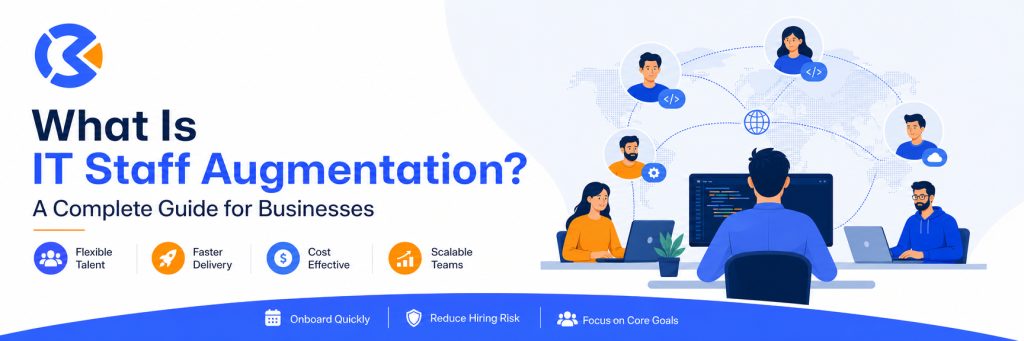
Every fast-growing software team eventually hits the same wall: there is more work than there are hands to do it. A backend developer leaves mid-sprint. A client wants a mobile app but nobody on staff knows Flutter. A QA backlog keeps growing because testing was never fully staffed in the first place.
This is the gap IT staff augmentation was built to close. Instead of freezing the roadmap while HR runs a three-month hiring process, a business brings in external developers who slot directly into the existing team and start producing work within days.
This guide explains what IT staff augmentation is, how it works, when it makes sense, and how it compares to outsourcing and managed services, so you can decide whether it fits your team.
Quick Answer: What Is IT Staff Augmentation?
IT staff augmentation is a staffing model where a business hires external developers, designers, or QA specialists from a third-party provider to work as part of its internal team, under its own management, for as long as the project needs them. It differs from outsourcing because the client directs the day-to-day work, and from full-time hiring because there is no long-term employment commitment.
What Is IT Staff Augmentation?
IT staff augmentation is a flexible IT staffing model that lets a company add external IT professionals, such as software developers, DevOps engineers, or QA testers, to its existing team without hiring them as full-time employees.
The augmented staff work inside the client’s workflow. They join daily standups, use the client’s project management tools, follow the client’s coding standards, and report to the client’s technical lead or project manager. The staffing provider handles recruitment, payroll, and contracts, but the client controls the actual work.
This model is different from traditional freelancing or short-term contracting because the relationship is usually longer, the engineer is dedicated to one client at a time, and the working arrangement is designed to feel like an in-house hire rather than a one-off gig.
In short: staff augmentation rents skilled capacity, not a finished product. The business still owns the roadmap, the architecture decisions, and the delivery process.
How Does IT Staff Augmentation Work?
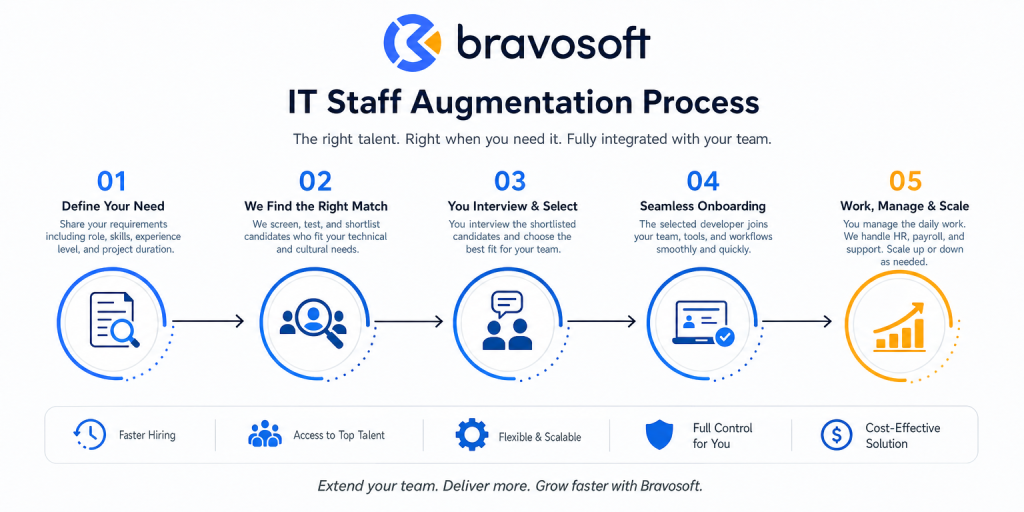
The process is fairly consistent across providers, even though the details vary. Most engagements follow four stages:
- Define the need. The company specifies the role, tech stack, seniority level, and expected duration. A vague brief like “we need a developer” produces slower, weaker matches than a specific one like “a mid-level React developer for six months to build a customer dashboard.”
- Match and vet candidates. The provider screens its talent pool and presents candidates who fit the technical and communication requirements. Reputable providers test coding ability and problem-solving, not just review a resume.
- Onboard the engineer. Once selected, the engineer is added to the client’s tools, repositories, and communication channels. They typically start contributing within the first one to two weeks.
- Manage the ongoing engagement. The client manages daily work, while the provider usually stays involved for contract administration, replacement if needed, and scaling the team up or down.
Throughout the engagement, the augmented developer effectively behaves like an internal hire. The main difference is who they are employed by and how billing works.
Types of IT Staff Augmentation
Not every augmentation engagement looks the same. Businesses generally use one of the following approaches:
- Short-term augmentation to cover a temporary gap, such as a developer on leave or a sudden spike in scope.
- Long-term augmentation to fill a permanent skills gap the company does not want to hire full-time for, such as ongoing DevOps support.
- Skill-specific augmentation to add a single specialist, for example a UI/UX designer for one release cycle.
- Team-based augmentation to add a small group, such as two developers and a QA engineer, that functions as a sub-team within the larger project.
What Does an IT Staff Augmentation Team Do?
The scope of work depends entirely on the role being filled. Augmented staff typically do the same work an in-house hire in that position would do. A few common examples:
- A React developer might join a product team to build new UI components, fix performance issues, or take ownership of the front-end while the in-house team focuses on backend work.
- A Node.js developer could be brought in to build APIs, integrate third-party services, or help a startup ship its MVP faster.
- A QA engineer might be added when a growing codebase has outpaced manual testing capacity, writing test cases and running regression cycles before releases.
- A DevOps engineer could set up CI/CD pipelines, manage cloud infrastructure, or fix reliability issues that in-house developers do not have the bandwidth or specialization to handle.
- A UI/UX designer might join a project for a defined period to redesign a product’s onboarding flow or prepare design systems for a new feature set.
In each case, the augmented professional works inside the client’s existing sprint cycles and reporting structure rather than delivering a separate, self-contained project.
How IT Staff Augmentation Benefits Businesses
The appeal of this model comes down to speed, flexibility, and access to skills that are hard to hire for locally.
- Faster access to talent. Recruiting a senior developer can take weeks or months. Augmentation providers usually place someone within one to two weeks.
- Lower hiring risk. If a role turns out to be temporary, the company is not left managing a layoff or an underused full-time employee.
- Access to specialized skills. Niche expertise, such as a specific framework or compliance-heavy domain knowledge, is often easier to rent than to hire permanently.
- Scalability. Teams can expand for a release push and contract afterward without renegotiating employment contracts.
- Cost predictability. Most engagements are billed hourly or monthly, which is easier to forecast than the fully loaded cost of a permanent employee, including benefits and overhead.
- Retained control. Unlike outsourcing a whole project, the client keeps ownership of architecture, priorities, and process.
When Should You Use IT Staff Augmentation?
Staff augmentation tends to work best in specific situations rather than as a default staffing strategy. It is generally a good fit when:
- A project has a clear technical direction but not enough hands to execute it on time.
- A specific skill gap exists, such as no in-house DevOps or mobile expertise.
- The need is temporary, tied to a launch, migration, or seasonal spike.
- The internal team has the leadership and processes to manage additional developers effectively.
- Hiring full-time is not justified by the workload, or the budget does not support a permanent headcount increase.
It is a weaker fit when a company has no technical leadership to direct external staff, or when the actual need is a fully managed outcome rather than extra hands, for example a business that wants a finished product delivered with minimal internal involvement.
IT Staff Augmentation vs Outsourcing
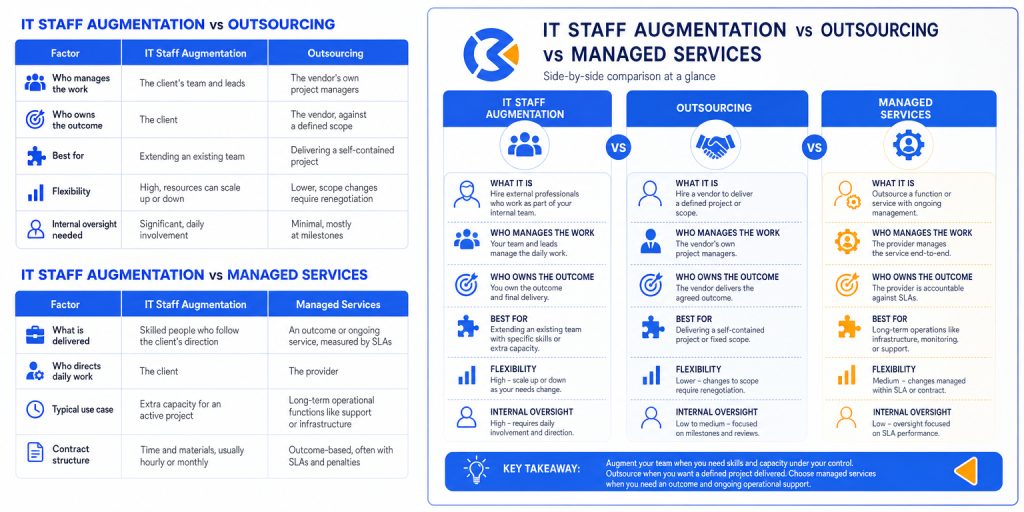
These two models are often confused because both involve hiring external help, but the control and accountability structure is different.
The core difference: in staff augmentation, the client manages the augmented staff and owns the outcome. In outsourcing, the vendor manages its own team and is responsible for delivering the agreed result.
| Factor | IT Staff Augmentation | Outsourcing |
| Who manages the work | The client’s team and leads | The vendor’s own project managers |
| Who owns the outcome | The client | The vendor, against a defined scope |
| Best for | Extending an existing team | Delivering a self-contained project |
| Flexibility | High, resources can scale up or down | Lower, scope changes require renegotiation |
| Internal oversight needed | Significant, daily involvement | Minimal, mostly at milestones |
IT Staff Augmentation vs Managed Services
Managed services go a step further than outsourcing. A managed services provider takes full responsibility for an entire function, such as infrastructure monitoring or application support, and is measured against service-level agreements rather than headcount.
| Factor | IT Staff Augmentation | Managed Services |
| What is delivered | Skilled people who follow the client’s direction | An outcome or ongoing service, measured by SLAs |
| Who directs daily work | The client | The provider |
| Typical use case | Extra capacity for an active project | Long-term operational functions like support or infrastructure |
| Contract structure | Time and materials, usually hourly or monthly | Outcome-based, often with SLAs and penalties |
Some companies use both models at once: augmented developers for active feature work, and a managed services arrangement for infrastructure that needs 24/7 coverage.
How Much Does IT Staff Augmentation Cost?
Pricing depends on the engineer’s seniority, specialization, and location. Providers typically bill in one of two ways:
- Hourly rates, common for shorter or variable-scope engagements.
- Monthly rates, common for long-term, full-time equivalent placements.
Rates vary significantly by region. Onshore talent in the United States or Western Europe generally costs more per hour than nearshore or offshore talent in regions such as South Asia or Eastern Europe, though the gap has narrowed as demand for specialized skills has grown globally.
For context on why specialized technical talent commands a premium, the U.S. Bureau of Labor Statistics reports that computer and information technology occupations carry a median wage well above the national average across all occupations, reflecting sustained demand for these skills.
A useful way to evaluate cost is not just the hourly rate, but the total cost of ownership. That includes onboarding time, management overhead, and the cost of a bad match, all of which are usually lower with a well-vetted augmentation provider than with ad hoc freelance hiring.
Common Challenges of IT Staff Augmentation
Staff augmentation is not risk-free. Being upfront about the limitations helps set realistic expectations.
- Management overhead. Augmented staff still need direction, code review, and integration into team culture. Companies without a strong technical lead may struggle to get full value from external developers.
- Onboarding time. Even a strong engineer needs time to learn a codebase and its context. Very short engagements may not fully offset this ramp-up cost.
- Communication gaps. Time zone differences and language barriers can slow collaboration if not addressed early with clear processes and overlap hours.
- Knowledge retention. If augmented staff leave without proper documentation or handover, institutional knowledge can walk out the door with them.
- Inconsistent vetting quality. Not every provider tests candidates rigorously. Weak vetting is one of the most common reasons augmentation engagements underperform.
Most of these risks are manageable with a provider that vets carefully, communicates clearly, and supports a proper handover process, rather than simply supplying resumes.
How to Choose an IT Staff Augmentation Company
The quality of the provider matters more than the pricing model. When evaluating options, look for:
- A real vetting process, including technical assessments and structured interviews, not just resume screening.
- Relevant experience in your industry or tech stack, since context reduces ramp-up time.
- Clear communication practices, including defined working hours, response times, and reporting.
- Transparent pricing, with no hidden fees for replacements, onboarding, or contract changes.
- Flexibility to scale, so the team can grow or shrink without renegotiating from scratch each time.
- References or a track record you can verify directly rather than take on faith.
It is also worth asking how quickly a provider can replace an engineer who is not working out. A good process protects the timeline even when an individual match does not succeed.
Is IT Staff Augmentation Right for Your Business?
A simple way to decide is to work through three questions:
- Do you have the technical leadership to direct additional developers day to day? If not, a managed service or a full outsourced project may fit better.
- Is the need temporary or specialized rather than a permanent core function? If the gap is short-term or skill-specific, augmentation is usually more efficient than a full-time hire.
- Do you need speed more than you need a fixed-scope deliverable? If getting started fast matters more than locking in a defined outcome, augmentation is built for that.
If the answers point toward needing extra hands inside a process you already control, staff augmentation is likely a strong fit. If you need a finished outcome with minimal internal oversight, outsourcing or managed services may serve you better.
Conclusion
IT staff augmentation gives businesses a way to add real engineering capacity without the delays of full-time hiring or the reduced control that comes with handing a project fully to an outside vendor. It works best when a company already has technical direction in place and simply needs more hands to execute it, whether that is a React developer for a new feature, a QA engineer to keep releases stable, or a DevOps specialist to fix infrastructure gaps.
Need to expand your development team without going through a lengthy hiring process? Explore Bravosoft’s IT team augmentation services to see how pre-vetted developers, designers, and QA specialists can join your team within a week.

Bravosoft is headquartered in Dhaka, Bangladesh. We work with startups, scale-ups, and enterprises across Europe, North America, and the Middle East, delivering software solutions remotely with the same accountability as a local team.
Our team includes frontend developers, backend engineers, QA specialists, UI/UX designers, and product managers with hands-on experience across 20+ technologies. Every specialist we place goes through a structured vetting process before they work on any client project.
We offer three main models: dedicated team augmentation for ongoing development needs, project based delivery for defined scope work, and MVP partnerships for startups looking to build and validate fast. We help you pick the right model based on your goals and budget.
MVP stands for Minimum Viable Product — and it’s one of the smartest ways to launch a new app, website, or software. In simple words, an MVP is a basic, working version of your product that includes only the core features needed to solve a problem for users. It’s not the final version — it’s the foundation.
We follow an agile sprint process with regular check-ins, progress reports, and built-in QA at every stage. You always know where the project stands, and nothing ships without passing our internal quality review first.