
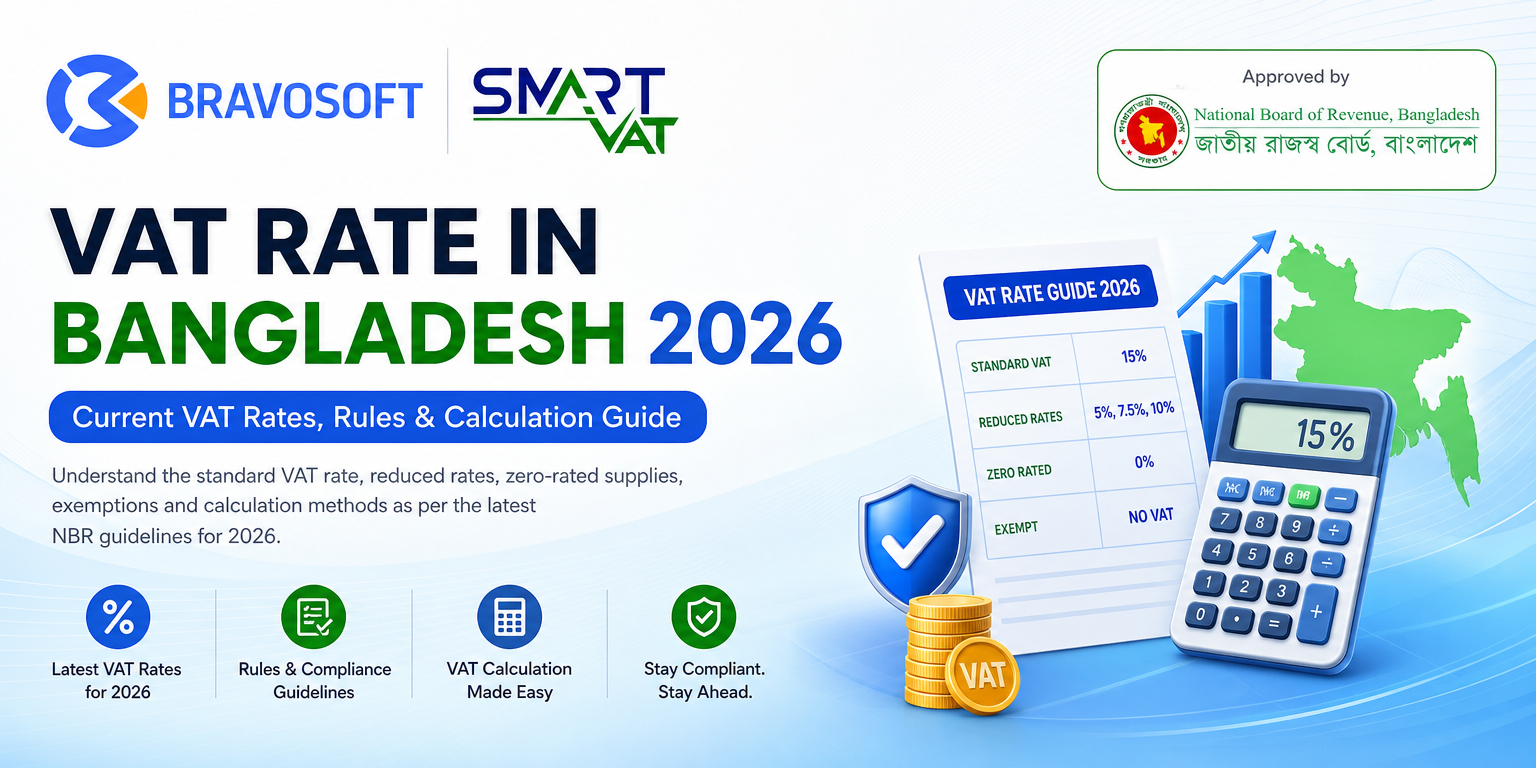
The standard vat rate in Bangladesh 2026 is 15%, and it applies to most goods and services under the VAT and Supplementary Duty Act, 2012, unless a specific item qualifies for a reduced rate, zero rating, or exemption under the First or Third Schedule. Reduced rates of 5%, 7.5%, and 10% apply to a defined list of goods and services, while exports and certain other supplies are zero-rated. This guide explains the standard rate, the reduced-rate categories, how VAT is calculated, and what businesses in Bangladesh need to know for VAT compliance in 2026.
What Is VAT in Bangladesh?
Value Added Tax (VAT) is a consumption tax charged at each stage of the supply chain, from import and manufacturing through wholesale, retail, and final sale to the consumer. Each registered business charges VAT on its sales (output VAT) and can generally reclaim the VAT it paid on its own eligible business purchases (input VAT), so the tax is ultimately borne by the end consumer rather than by businesses in the middle of the chain.
VAT in Bangladesh is administered by the National Board of Revenue (NBR) under the Value Added Tax and Supplementary Duty Act, 2012, which replaced the earlier VAT Act of 1991. The 2012 Act, along with the rules, SROs (Statutory Regulatory Orders), and notifications issued under it, sets out the standard rate, the reduced-rate schedules, registration thresholds, and return-filing obligations that businesses must follow.
Two terms come up constantly in VAT compliance:
- Output VAT: the VAT a business charges its customers on taxable sales.
- Input VAT: the VAT a business pays on its own taxable business purchases, which can generally be credited against output VAT, subject to conditions under the Act.
What Is the VAT Rate in Bangladesh in 2026?
The standard VAT rate in Bangladesh in 2026 is 15%. Under the VAT and Supplementary Duty Act, 2012, VAT is charged at 15% on the transaction value of most imports and supplies of goods and services, unless a specific good or service is listed under a reduced rate, a fixed VAT amount, zero rating, or an exemption in the First or Third Schedule of the Act.
Beyond the standard rate, four other VAT treatments exist side by side in Bangladesh, and they are not interchangeable:
| VAT Treatment | Rate | Common Application | Important Note |
| Standard VAT | 15% | Most goods, services, and imports not separately listed | Default rate under the VAT and SD Act, 2012 |
| Reduced or fixed rate | 5%, 7.5%, 10%, or a fixed amount | Specific goods and services listed in the Third Schedule | Applies only to items named in the relevant table or SRO |
| Zero-rated | 0% | Mainly exports and a limited list of specified supplies | Input VAT credit is still allowed, unlike exemption |
| Exempt | No VAT charged | Items listed in the First Schedule (for example, certain essential and social-purpose goods and services) | Input VAT on related purchases is generally not creditable |
| Turnover Tax | A rate or fixed amount set by NBR | Small businesses whose annual turnover falls within the enlistment band | Charged instead of VAT, and no input tax credit is allowed |
Important note: VAT rates, thresholds, and category lists in Bangladesh are revised through the annual Finance Act, NBR SROs, and notifications. Always confirm the applicable rate for a specific good or service against the current NBR notification or the VAT Online portal (vat.gov.bd) before filing or invoicing.
VAT Rates for Different Goods and Services in Bangladesh
The 15% standard rate is the default position for most commercial transactions: general retail and wholesale trade, most manufactured goods, most professional and IT/ITES services, most imports, and most e-commerce sales of goods and services fall under it unless a specific SRO says otherwise.
A defined list of goods and services instead attracts a reduced or fixed VAT rate under the Third Schedule of the VAT and Supplementary Duty Act, 2012. Depending on the item and the stage of supply, this can include certain construction and real estate services, specified trading and manufacturing categories, and selected consumer goods and raw materials. For example, some manufacturers of furniture and similar goods pay the standard rate on direct sales to consumers but a reduced rate at the retail showroom stage when supported by a valid VAT-paid tax challan.
Restaurant services, hotel services, and similar hospitality supplies have historically been treated under a reduced VAT rate rather than the full 15% standard rate, though the exact rate and the conditions attached to it (for example, air-conditioned versus non-air-conditioned premises) are set by specific NBR SROs and can change from one budget cycle to the next.
Exports of goods and certain specified services are zero-rated, meaning no VAT is charged to the overseas buyer while the exporter can still claim input VAT credit on related purchases. Because sector and product-level VAT treatment depends on the exact HS code, the nature of the service, and the governing SRO, businesses should verify the applicable rate for their specific goods or services against the current NBR VAT rate schedule rather than relying on a general industry assumption.
Standard VAT Rate vs Reduced VAT Rate vs Zero-Rated vs VAT Exempt
These four categories are often confused, but they have different legal and commercial consequences:
| Category | Meaning | VAT Charged to Customer? | Input VAT Treatment |
| Standard rate | The default 15% VAT rate applied to most supplies | Yes, at 15% | Input VAT on related purchases is generally creditable |
| Reduced or fixed rate | A lower rate (5%, 7.5%, 10%) or fixed amount set for specific listed items | Yes, at the applicable reduced or fixed rate | Input VAT credit rules can differ by category; verify per SRO |
| Zero-rated | VAT is charged at a rate of 0%, mainly on exports | No (rate is 0%) | Input VAT on related purchases can generally still be claimed |
| Exempt | The supply falls outside the VAT system entirely under the First Schedule | No VAT is charged at all | Input VAT on related purchases is generally not creditable |
The practical distinction that matters most for businesses is this: zero-rated supplies stay inside the VAT system and preserve the right to claim input VAT, while exempt supplies sit outside the VAT system and generally do not carry that right. Turnover tax is a separate, simplified regime altogether, charged instead of VAT rather than as a rate within it, and it does not allow input tax credit.
How to Calculate VAT in Bangladesh
VAT can be calculated in two directions, depending on whether the price you are working with already includes VAT.
Example 1: VAT Added to a VAT-Exclusive Price
If a product’s price is BDT 1,000 (VAT-exclusive) and the standard VAT rate of 15% applies:
- VAT amount = Price x VAT rate = BDT 1,000 x 15% = BDT 150
- Final price (VAT-inclusive) = BDT 1,000 + BDT 150 = BDT 1,150
Example 2: Extracting VAT from a VAT-Inclusive Price
If a quoted price of BDT 1,150 already includes 15% VAT, the VAT-exclusive price and the VAT amount are found using the reverse formula:
- VAT-exclusive price = VAT-inclusive price / (1 + VAT rate) = BDT 1,150 / 1.15 = BDT 1,000
- VAT amount = VAT-inclusive price minus VAT-exclusive price = BDT 1,150 minus BDT 1,000 = BDT 150
The same formulas apply at any applicable rate; simply replace 15% with the reduced or fixed rate that applies to the specific goods or services in question.
Input VAT and Output VAT
Output VAT is the VAT a business charges on its taxable sales during a tax period. Input VAT is the VAT the same business pays on its own eligible business purchases and imports during that period. Under the credit-invoice method used in Bangladesh, a VAT-registered business generally nets these two figures against each other to arrive at the amount payable to, or refundable from, the NBR:
- Net VAT payable = Output VAT minus eligible Input VAT
For example, if a business collects BDT 300,000 in output VAT on its sales in a month and has BDT 220,000 in eligible input VAT on its purchases for the same period, the net VAT payable to the NBR for that month is BDT 80,000.
Claiming input VAT is not automatic. It generally depends on holding a valid VAT invoice (Mushak 6.3) from a VAT-registered supplier showing the correct BIN, on the purchase being genuinely related to the business’s taxable economic activity, and on the item not falling under a category where input credit is restricted by law. Businesses that keep incomplete purchase documentation risk having input VAT claims disallowed on audit, which increases their effective VAT cost.
Who Needs to Register for VAT in Bangladesh?
VAT registration and the turnover-based enlistment system determine whether a business must charge standard VAT, pay turnover tax, or fall outside the system altogether. Multiple recent NBR notifications and the Finance Act have adjusted these thresholds, so businesses should treat the following as a general framework rather than a fixed number, and confirm the exact figure in force at the time on the VAT Online portal (vat.gov.bd) or with the NBR.
- Businesses whose annual turnover exceeds the mandatory VAT registration threshold must register for VAT, obtain a Business Identification Number (BIN), and charge the standard rate on taxable supplies.
- Businesses within a lower enlistment band, below the mandatory VAT registration threshold but above a minimum floor, may instead enlist for Turnover Tax, a simplified tax charged on total turnover rather than on value addition.
- Businesses below the enlistment floor generally have no VAT registration or turnover tax obligation, though they may still register voluntarily.
- Certain categories, such as importers, exporters, and specified service providers, must obtain a BIN regardless of turnover.
Recent NBR measures have also made BIN registration a precondition for a growing range of everyday business activities, including opening or operating certain bank accounts, taking bank loans, renewing trade licences, and registering vehicles in a business name. This means many businesses now need a BIN for practical operating reasons even before they cross a turnover threshold.
Important note: VAT and turnover-tax registration thresholds have been revised more than once through recent Finance Acts and NBR SROs, and different NBR publications currently show different threshold figures. Do not rely on an old blog post or an outdated NBR FAQ page. Confirm the exact threshold in force for the current tax period directly on vat.gov.bd or with the NBR before deciding whether to register.
VAT Return Filing and Mushak Forms
VAT-registered businesses in Bangladesh must file a periodic VAT return using the official Mushak 9.1 form, submitted through the NBR’s VAT Online portal. The return reports taxable sales (output VAT), taxable purchases (input VAT), adjustments, and the resulting net VAT payable or refundable for the period. A return is generally due within a set number of days after the end of the tax period, and it must still be filed as a nil return even in a period with no transactions.
Supporting documentation matters as much as the return itself. Sales are backed by Mushak 6.3 VAT invoices, and businesses are expected to retain purchase and sales registers, treasury challans for VAT paid, and copies of submitted returns for the retention period set by the Act, since these records are what an NBR audit will test against the figures declared on the Mushak 9.1.
Common VAT Compliance Mistakes Businesses Make in Bangladesh
- Applying the standard 15% rate to a supply that actually qualifies for a reduced, fixed, zero, or exempt treatment, or the reverse
- Relying on an outdated VAT rate list instead of the current Finance Act and NBR SRO
- Calculating VAT incorrectly on invoices, especially when converting between VAT-inclusive and VAT-exclusive prices
- Missing or incomplete purchase documentation, which puts input VAT credit at risk
- Claiming input VAT on purchases that do not meet the legal eligibility conditions
- Filing the Mushak 9.1 return late, or not filing a nil return in a quiet month
- Poor record keeping that makes it difficult to reconcile sales, purchases, and VAT data during an audit
- Errors in BIN, invoice, or transaction details entered on the Mushak forms
- Depending on manual, spreadsheet-based VAT calculation across multiple branches or sales channels, which increases the chance of mismatched figures
- Failing to reconcile monthly sales records against the VAT actually reported and paid
How VAT Software Helps Businesses Manage VAT
As transaction volumes grow, manual VAT tracking in spreadsheets becomes harder to keep accurate and audit-ready. Purpose-built VAT management software can help businesses in Bangladesh in several practical ways:
- Automated, rate-aware VAT calculation across sales channels, so the correct standard, reduced, or fixed rate is applied consistently
- Transaction-level VAT tracking that keeps output VAT and input VAT organised as they occur, rather than reconstructed at month-end
- VAT reconciliation between sales, purchases, and the figures reported to the NBR
- Faster preparation of Mushak reports for monthly filing
- Centralised VAT records that are easier to produce during an NBR audit
- Fewer manual calculation errors compared with spreadsheet-based processes
- Integration with existing ERP, POS, and accounting systems
- Consolidated VAT management across multiple branches or business locations
For businesses that want to move away from manual VAT tracking, VAT management software in Bangladesh such as SmartVAT is built specifically around the requirements of the VAT and Supplementary Duty Act, 2012, and is designed to automate calculation, reconciliation, and reporting for businesses operating under NBR rules. Bravosoft’s own SmartVAT solution follows the same approach for businesses that also want VAT automation integrated with their broader ERP and accounting workflow, alongside solutions such as BASE ERP for manufacturing and furniture businesses that need inventory, production, and finance connected in one platform.
Important Note on VAT Rate Accuracy
VAT rates, thresholds, and category lists in Bangladesh change through the annual Finance Act, NBR SROs, and notifications, and different rates can apply to the same general category of goods or services depending on HS code, stage of supply, and specific legal conditions. This article is intended as a general informational guide and does not constitute personalised tax or legal advice. Businesses with complex transactions, multiple product lines, or cross-border supplies should verify the current rate on the NBR’s official channels or the VAT Online portal (vat.gov.bd), and consult a qualified VAT professional before applying a rate to a specific transaction.
Frequently Asked Questions:
The standard VAT rate in Bangladesh in 2026 is 15%, applied under the VAT and Supplementary Duty Act, 2012. Reduced rates of 5%, 7.5%, and 10%, along with zero-rated and exempt treatments, apply to specific goods and services listed in the Act’s schedules.
Yes, 15% is the standard VAT rate for most goods, services, and imports in Bangladesh. However, a defined list of items is instead subject to a reduced rate, a fixed VAT amount, zero rating, or exemption, so 15% is the default rather than a universal rate.
The standard VAT rate in Bangladesh is 15%, set under the VAT and Supplementary Duty Act, 2012, and applied to the transaction value of most taxable supplies and imports.
No. Some goods and services are taxed at reduced rates of 5%, 7.5%, or 10%, some are zero-rated (mainly exports), and some are fully exempt under the First Schedule of the Act. The applicable rate depends on the specific item, HS code, and any governing SRO.
Exempt supplies fall outside the VAT system entirely, no VAT is charged, and input VAT on related purchases is generally not creditable. Zero-rated supplies stay inside the VAT system at a 0% rate, so no VAT is charged to the customer, but the supplier can generally still claim input VAT credit on related purchases.
To add VAT to a VAT-exclusive price, multiply the price by the VAT rate and add the result to the price. To extract VAT from a VAT-inclusive price, divide the price by (1 plus the VAT rate) to get the VAT-exclusive value, then subtract that from the original price to find the VAT amount.
Input VAT is the VAT a registered business pays on its own eligible business purchases and imports. It can generally be credited against the business’s output VAT, subject to holding valid purchase documentation and meeting the eligibility conditions under the VAT and Supplementary Duty Act, 2012.
Output VAT is the VAT a registered business charges its customers on its taxable sales of goods or services during a tax period.
Businesses whose annual turnover exceeds the mandatory VAT registration threshold set by the NBR must register for VAT and obtain a BIN. Businesses in a lower turnover band may instead enlist for Turnover Tax. Because thresholds have changed through recent Finance Acts, businesses should confirm the current figure on vat.gov.bd.
BIN stands for Business Identification Number, the unique registration number issued by the NBR to a VAT-registered or enlisted business. It is required to charge VAT, claim input VAT credit, and, increasingly, to carry out routine activities such as opening certain bank accounts or renewing a trade licence.
VAT-registered businesses generally file the Mushak 9.1 VAT return monthly through the NBR’s VAT Online portal, even in months with no transactions, in which case a nil return must still be submitted.
Yes. VAT management software can automate VAT calculation across sales channels, track input and output VAT at the transaction level, support reconciliation, and speed up Mushak report preparation, which reduces the manual errors that commonly cause compliance problems.