
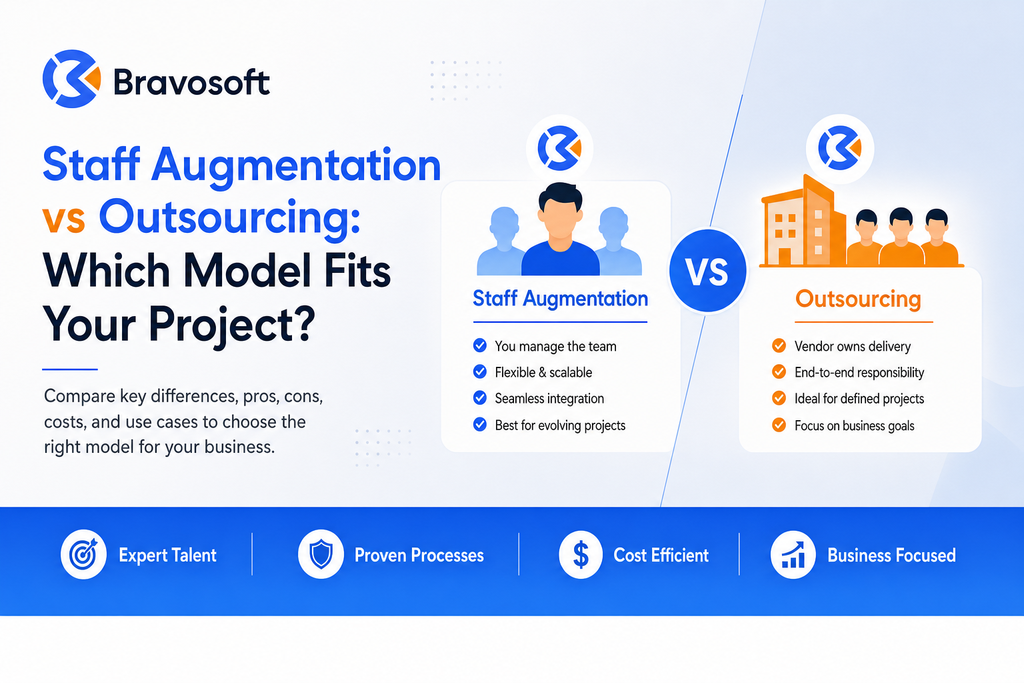
Most software leaders eventually hit the same wall: the roadmap is bigger than the team that has to build it. The question that follows is rarely “should we get help,” it is “what kind of help do we actually need.” Two models tend to come up in that conversation: staff augmentation and outsourcing.
They get talked about as if they are interchangeable, but they solve different problems. Staff augmentation adds people to a team you already run. Outsourcing hands a defined piece of work, or an entire project, to a partner who runs it for you. Neither model is universally better. The right choice depends on how much control you want to keep, how defined your project scope is, what your internal team already looks like, and how long you expect the work to last.
This article breaks down both models in practical terms, compares them directly, and gives you a framework for deciding which one fits your situation, including cases where the answer is actually both.
What Is Staff Augmentation?
Staff augmentation is a staffing model where a company adds external developers, designers, or QA specialists to its existing team on a temporary or ongoing basis. The client retains day to day management of the work. The augmented staff join existing sprints, tools, and communication channels, functioning as an extension of the internal team rather than a separate unit.
This distinction matters because it changes who is accountable for delivery. In staff augmentation, the client’s internal team, or an internal technical lead, still owns the roadmap, sets priorities, and makes architectural decisions. The augmented developers execute against that plan, working alongside existing employees and taking day to day direction from the client rather than from an outside manager.
A typical engagement looks like this: a company already has a product team, but is short two backend developers for a quarter. Instead of running a full hiring cycle, it brings in two contract developers who join the existing Slack workspace, attend the same standups, and pull tickets from the same backlog. They report to the same engineering manager as everyone else on the team, following whatever delivery process the internal team already uses.
Staff augmentation tends to make the most sense when a company already has the processes and technical leadership in place and simply needs more hands, or a specific skill it does not currently have in house, such as a Flutter developer for a one-off mobile release.
What Is Software Development Outsourcing?
Software development outsourcing is a model where a company contracts an external development team or agency to deliver a defined piece of work, a specific feature set, or an entire project, under that vendor’s own management. Instead of joining the client’s internal team, the outsourcing partner runs its own project management, assigns its own developers, and is responsible for the final result.
Outsourcing has long been used for non-core functions beyond software as well, from IT infrastructure to customer support and HR processes, and the same underlying logic applies to software delivery: an outside provider takes ownership of a function so the client does not have to. The client sets requirements, reviews milestones, and approves deliverables, but does not typically manage individual developers day to day. Communication tends to happen at the project or product level rather than the task level: status calls, sprint reviews, and milestone demos rather than daily task assignment.
A practical example: a company without any internal engineering team wants to build a new customer portal. It outsources the entire build to a development partner, providing a product brief and business requirements. The partner assigns a project manager, developers, and QA to the engagement and is responsible for delivering a working product against an agreed scope and timeline.
Outsourcing tends to fit best when a company does not have the internal capacity or expertise to manage software delivery itself, or when a project has a reasonably defined scope that can be handed off cleanly.
Staff Augmentation vs Outsourcing: Key Differences
| Factor | Staff Augmentation | Outsourcing |
| Team ownership | Client owns the team | Vendor owns the team |
| Management responsibility | Client manages day to day work | Vendor manages day to day work |
| Project control | High, client directs priorities | Lower, vendor directs execution |
| Developer integration | Developers work inside client’s existing team | Developers work inside vendor’s team |
| Flexibility | Easy to add or remove individual skill sets | Changes usually go through vendor’s process |
| Scalability | Scales incrementally, person by person | Scales at the project or workstream level |
| Project scope | Works well for evolving or unclear scope | Works best with a defined scope |
| Communication | Direct, daily, task level | Milestone and status level |
| Hiring responsibility | Client still directs technical decisions | Vendor handles technical decisions within scope |
| Technical oversight | Retained by client | Delegated to vendor |
| Project management | Usually the client’s responsibility | Usually included by the vendor |
| Cost structure | Typically time and materials, per resource | Often project based or milestone based |
| Best use cases | Skill gaps, capacity gaps, long running teams | Full projects, MVPs, defined deliverables |
| Long-term suitability | Strong for ongoing product development | Strong for time-boxed initiatives |
Staff Augmentation vs Outsourcing: Pros and Cons
Advantages of Staff Augmentation
- Keeps technical and product decisions inside the company
- Faster to add specific skills without a full hiring process
- Easy to scale a team up or down as needs change
- Augmented developers work inside existing tools and workflows
- Useful for filling gaps on a long-term in-house development team
Disadvantages of Staff Augmentation
- Requires the client to already have management and technical leadership in place
- Client remains responsible for coordinating the augmented staff
- Not ideal if the company has no internal team to integrate developers into
- Onboarding still takes some ramp-up time, even with experienced developers
Advantages of Outsourcing
- Vendor takes ownership of delivery, reducing the client’s management burden
- Useful when a company has little or no internal engineering capacity
- Can bring a full team, including project management and QA, in one engagement
- Works well for clearly scoped projects with a defined end point
Disadvantages of Outsourcing
- Less day to day control over how work is executed
- Requires clear upfront requirements, since changes go through the vendor’s process
- Communication happens at a higher level, which can slow down fast-moving decisions
- Switching vendors mid-project is more disruptive than adjusting an augmented team
When Should You Choose Staff Augmentation?
Staff augmentation tends to be the better fit when:
- You already have an internal engineering team and technical leadership
- You need a specific skill set your current team lacks, such as a particular framework or platform
- You need to scale your team quickly without going through a full hiring cycle
- You want direct control over how developers work and what they prioritize
- Your project requirements are likely to shift as the product evolves
- You need additional developers for an extended period, not just a single deliverable
When Should You Choose Outsourcing?
Outsourcing tends to be the better fit when:
- You need an entire project delivered, not just additional capacity
- You do not currently have an internal engineering team
- You want a partner to take end-to-end ownership of delivery
- The project has a relatively defined scope and timeline
- You want a single point of accountability for the outcome
- You need access to multiple technical capabilities, such as design, development, and QA, in one engagement
Staff Augmentation vs Outsourcing Cost
Cost is one of the most common questions in this comparison, and also one of the easiest to oversimplify. There is no fixed rule that says staff augmentation is always cheaper than outsourcing. Total cost depends on several variables:
- Developer seniority and specialization required
- Technology stack and how in demand it is
- Team size and how many roles are needed
- Duration of the engagement
- Complexity of the project
- How much project management and coordination is required
- Geography of the development team
- Whether QA and DevOps support are included
- How much internal project management capacity the client already has
Staff augmentation often has a lower per-resource cost because you are paying for developer time, not a fully managed delivery package. But if your internal team lacks spare project management capacity, that overhead does not disappear, it just shifts onto your own staff. Outsourcing often bundles project management, QA, and delivery accountability into the engagement, which can raise the headline cost but reduce the coordination burden on your side. The more useful question is not “which model is cheaper” but “which model matches the coordination capacity you already have.”
Staff Augmentation vs Outsourcing: Which Gives You More Control?
Staff augmentation gives you more control. Because the client manages the augmented developers directly, it retains authority over task assignment, technical decisions, and day to day priorities. Outsourcing shifts a meaningful share of that control to the vendor, in exchange for the vendor taking on responsibility for delivering the agreed outcome.
The distinction plays out at several levels:
- Developer-level control: In staff augmentation, you assign tasks directly. In outsourcing, the vendor’s project manager typically does.
- Technical decision-making: Staff augmentation keeps architecture and technical direction with the client. Outsourcing delegates a portion of these decisions to the vendor, within the agreed scope.
- Project management: Staff augmentation usually relies on the client’s own project management. Outsourcing typically includes it as part of the engagement.
- Vendor ownership: In outsourcing, the vendor is accountable for the final deliverable. In staff augmentation, the client remains accountable, since it directs the work.
Neither level of control is inherently better. More control means more responsibility for coordination. Less control means trusting a partner to manage execution, which can be the right trade-off when a company does not want to run delivery itself.
Can You Combine Staff Augmentation and Outsourcing?
Yes, and in practice many companies use a hybrid approach rather than treating this as an either-or decision. A common pattern: a company outsources the build of a new product to a development partner for end-to-end delivery, while separately augmenting its internal team with a specialized DevOps engineer for an unrelated, ongoing initiative. Another version: a company runs its core product development in house, using staff augmentation to fill specific skill gaps, while outsourcing a self-contained piece of work, such as a one-time platform migration, to a separate vendor.
The two models are not mutually exclusive because they answer different questions. Staff augmentation answers “how do we get more of the right people into our existing team.” Outsourcing answers “who can take full ownership of this defined piece of work.” A company can reasonably need both answers at once, for different parts of its roadmap.
How to Choose the Right Model
A simple way to frame the decision:
Choose staff augmentation if:
- You need people, not a fully managed project
- Your team already manages development internally
- You need flexibility to adjust team composition over time
- You want direct, day to day control over the work
Choose outsourcing if:
- You need ownership of a defined project, not just extra capacity
- You want an external team to manage delivery end to end
- Your internal engineering resources are limited or nonexistent
- You want a single vendor accountable for the outcome
If your team already runs an agile process built around collaboration and continuous delivery, staff augmentation usually fits more naturally, since new developers can join that existing rhythm. If you do not have that structure in place yet, outsourcing gives you access to a team that already does.
Staff Augmentation vs Outsourcing: Quick Decision Checklist
Before choosing a model, it helps to answer these questions honestly:
- Do we already have an internal engineering team and technical leadership?
- Is the project scope clearly defined, or likely to change?
- Do we want day to day control over developers, or are we comfortable delegating execution?
- Do we have spare project management capacity, or do we need that included?
- Is this a long-running need, or a defined, time-boxed deliverable?
- Do we need a single skill set, or a full multidisciplinary team?
If most of your answers point toward “we manage this ourselves, we just need people,” staff augmentation is likely the better starting point. If most point toward “we need someone else to own this,” outsourcing is likely the better fit.
Conclusion
Staff augmentation and outsourcing solve different problems, even though they both get grouped under the same conversation about external development help. Staff augmentation keeps control and management inside your company while adding the people you need. Outsourcing shifts ownership of a defined project to a partner who manages delivery for you. The right decision depends less on which model is generically better, and more on how much control you want to keep, how defined your project scope already is, and whether your internal team has the capacity to manage additional developers.
Companies that already run their own development process and simply need more engineering capacity, in specific technologies like React, Vue, Angular, Node.js, .NET Core, Flutter, Kotlin, or Swift, often find that IT team augmentation is the more direct path, since it lets developers plug into an existing team without handing over project ownership. If your team is exploring how staff augmentation services could fill a specific gap, or you are weighing that against full-cycle software development support, it is worth mapping your project against the checklist above before committing to either model. And if you are earlier in the process and still shaping the product itself, it can help to look at how a product development engagement or an MVP build is typically structured, so you know what kind of support the next stage of your roadmap will actually need.
Staff augmentation adds external developers to your existing team, and you continue to manage the work directly. Outsourcing hands a defined project or scope of work to an external partner, who manages delivery under its own project structure. The core difference is who controls day to day execution.
Neither model is universally better. Staff augmentation works well when you already have internal technical leadership and want more control over execution. Outsourcing works well when you need an external team to own delivery end to end. The right choice depends on your project scope, internal capacity, and how much control you want to retain.
Not always. Staff augmentation often has a lower per-resource cost, but requires your internal team to handle project management. Outsourcing often bundles management and delivery accountability into the cost. The total cost depends on team size, duration, technology stack, and how much coordination is already included.
The client manages augmented developers directly. They typically join existing sprints, tools, and reporting structures, and take direction from the client’s internal technical leadership or project managers, similar to any other member of the internal team.
Outsourcing makes sense when you do not have an internal engineering team, need an entire project delivered rather than incremental capacity, or want a single vendor accountable for the outcome. It also fits well for projects with a clearly defined scope and timeline.
Yes. Staff augmentation is commonly used for long-running product development, not just short-term gaps. Companies often keep augmented developers engaged for months or years as an extension of their core team, scaling the number of augmented staff as the roadmap changes.
Yes. Many companies outsource a self-contained project while separately using staff augmentation to fill ongoing skill gaps in their internal team. The two models solve different problems and can run in parallel without conflict.
Start by assessing whether you already have internal technical leadership and project management capacity. If you do, and you want direct control, staff augmentation usually fits better. If you do not, or you want a single partner accountable for a defined deliverable, outsourcing usually fits better.