
Many growing companies run on a patchwork of tools. Accounting sits in one package, inventory in a spreadsheet, sales leads in a CRM nobody fully trusts, and production schedules on a whiteboard. Every handoff between these tools creates delays, duplicate data entry and reports that never quite agree with each other.
Odoo ERP addresses this with a modular, integrated architecture. Accounting, Inventory, Manufacturing, Sales, Purchase, CRM, Point of Sale, eCommerce, Project, HR and other apps share one database, so a sales order can flow into a delivery, an invoice and a financial report without retyping data. That design makes Odoo useful across many sectors. It does not make it the right answer for every business, and this guide explains where the fit is strongest and why.
Which Industries Benefit Most From Odoo ERP?
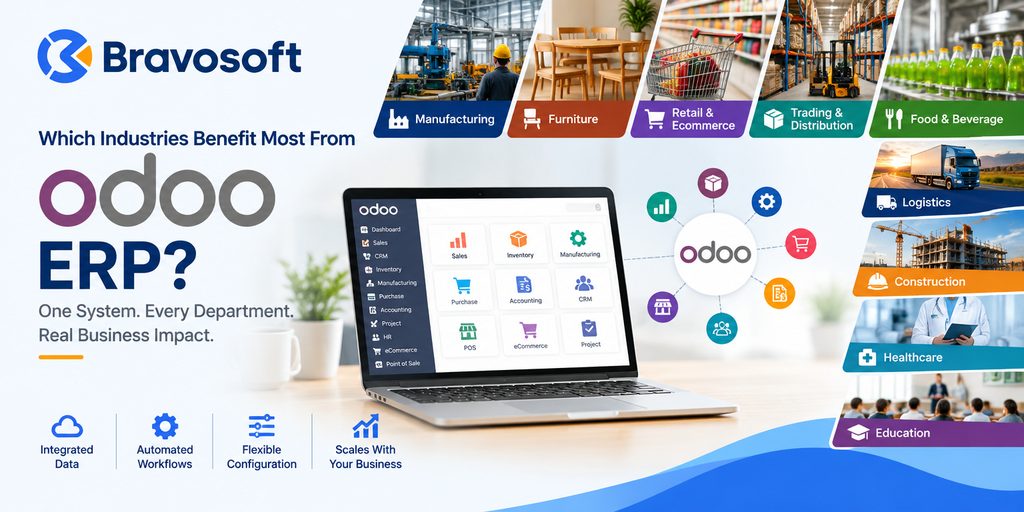
Short answer: Odoo ERP benefits most in industries where sales, inventory, purchasing, production and accounting must work together. That includes manufacturing, furniture, retail and ecommerce, trading and distribution, wholesale, food and beverage, logistics, construction, and project based service businesses. Healthcare, pharmaceutical and education organizations can also benefit for administrative and supply workflows.
The rest of this article explains the reasoning behind that answer, industry by industry, so you can judge whether your own operation matches.
Why Odoo Works Across Different Industries
Odoo is not one monolithic product. It is a set of apps that share the same data model. A business starts with the modules it needs, such as Inventory and Accounting for a trading company, and adds others later, such as Manufacturing, Quality or eCommerce, without changing platforms.
Three characteristics explain why so many industries use Odoo ERP:
- Data centralization. Customers, products, stock levels, invoices and employee records live in one place, so departments work from the same numbers.
- Workflow automation. Reordering rules, approval flows, invoicing triggers and delivery documents can be automated instead of handled manually.
- Configurability. Odoo can be adapted through settings, product variants, custom fields, automated actions and, where needed, custom modules.
When evaluating any industry, it helps to separate three levels of capability. Standard functionality works after installation and basic setup. Configurable functionality needs process design, such as pricing rules, warehouse routes or approval chains. Custom development or integration is required for unusual workflows, local compliance formats, specialized equipment or legacy system links. Most real projects use all three, which is why a structured approach to Odoo implementation services matters more than the module list alone. Bravosoft works in this space, covering process analysis, implementation, customization and integration for businesses that need Odoo adapted to how they actually operate.
Odoo ERP for Manufacturing
Direct answer: Manufacturers benefit from Odoo because it connects production planning, inventory, purchasing, quality and accounting in one system. Bills of materials, work orders and work centers link directly to stock and procurement, giving managers visibility into material availability, production progress and product cost.
Common challenges: Manufacturers often struggle with material shortages discovered too late, production plans disconnected from purchasing, poor visibility into work in progress, and product costs that finance cannot reconcile with the shop floor.
Relevant Odoo modules: Manufacturing, Inventory, Purchase, Quality, Maintenance, PLM, Sales and Accounting.
How it improves workflows: In Odoo Manufacturing, a bill of materials documents the components and quantities needed to produce or repair a product. When work orders are enabled, operations can be assigned to work centers and tracked as manufacturing orders progress. Component consumption reduces inventory, finished goods are received into stock, and purchase needs can be triggered from demand. Quality checks and equipment maintenance can be attached to the same operations.
Example process: A customer order for 500 units confirms a sales order, which creates a manufacturing order. Odoo checks component availability, flags shortages, suggests purchase orders, schedules work orders, and updates stock and cost records as production completes.
When Odoo fits: Discrete and light process manufacturers, assemblers, and make to order producers with moderate complexity are a strong match.
Implementation considerations: Very specialized production planning, advanced scheduling optimization or machine level integration usually requires configuration beyond the defaults and sometimes custom development.
Odoo ERP for Furniture Businesses
Direct answer: Furniture businesses benefit from Odoo when they need to handle product variants, custom orders, production, inventory and delivery in one workflow. Variants for size, material and finish can be managed on one product, while manufacturing and sales stay connected.
Common challenges: Furniture companies manage many variants of the same product, made to order pieces, raw material stock such as wood, fabric and hardware, and delivery scheduling for bulky goods.
Relevant Odoo modules: Sales, Manufacturing, Inventory, Purchase, eCommerce, Point of Sale, Accounting and Project (for fit out or installation work).
How it improves workflows: Product variants let a single sofa or table exist in multiple configurations, each with its own bill of materials where needed. Showrooms can use Point of Sale, online sales can run through eCommerce, and both draw from the same inventory. Custom orders can move from quotation to production to delivery without retyping specifications.
When Odoo fits: Manufacturers with their own factory, showroom chains, and businesses that combine retail with made to order production.
Implementation considerations: Product configurators with complex rules, such as pricing that depends on dimensions, often need configuration work or a custom module.
Odoo ERP for Retail and Ecommerce
Direct answer: Retail and ecommerce businesses benefit from Odoo because Point of Sale, eCommerce, Inventory and Accounting share one product and customer database. Stock levels, pricing and customer records stay consistent across physical stores and online channels.
Common challenges: Retailers face stock mismatches between store and web, inconsistent pricing, weak customer data, and slow month end reconciliation when sales channels run on separate systems.
Relevant Odoo modules: Point of Sale, eCommerce, Website, Inventory, Sales, CRM, Email Marketing, Purchase and Accounting.
How it improves workflows: A sale at the counter and a sale on the website both reduce the same stock. Loyalty and pricing rules can be managed centrally, and purchase reordering can follow real sales. Customer purchase history supports marketing and follow up through CRM and marketing tools.
Example process: A retailer with three stores and an online shop manages one product catalog, replenishes each location from a central warehouse, and reviews sales by channel in a single set of reports.
When Odoo fits: Multi store retailers, brands selling both offline and online, and growing ecommerce companies outgrowing basic storefront tools.
Implementation considerations: Payment gateways, courier services, marketplaces and local invoicing requirements should be checked early. Some connections are available as standard or community integrations, while others need custom work.
Odoo ERP for Trading and Distribution
Direct answer: Trading and distribution companies benefit from Odoo because their business depends on accurate inventory, purchasing, pricing and receivables. Odoo links purchase orders, warehouse operations, sales orders, customer pricing and accounting in a single flow.
Common challenges: Distributors deal with high SKU counts, supplier lead times, customer specific price lists, credit control, and stock spread across warehouses or vans.
Relevant Odoo modules: Inventory, Purchase, Sales, Accounting, CRM and Barcode features for warehouse handling.
How it improves workflows: Reordering rules can generate purchase requests when stock falls below set levels. Price lists can vary by customer group or quantity. Warehouse staff can receive, pick and ship using structured transfers, and finance sees receivables and payables update from the same transactions.
Example process: A distributor receives goods against a purchase order, updates stock automatically, confirms a customer order, picks and delivers the goods, then issues an invoice and tracks payment.
When Odoo fits: Import and export traders, FMCG distributors, and companies moving from spreadsheets to structured inventory control.
Implementation considerations: Route sales, van sales, commission structures and credit approval rules may need custom configuration.
Odoo ERP for Food and Beverage Businesses
Direct answer: Food and beverage companies benefit from Odoo because it supports lot tracking, expiration dates, recipes through bills of materials, quality checks and purchasing. Traceability and stock rotation are central concerns in this sector, and Odoo Inventory provides tools for both.
Common challenges: Perishable stock, batch traceability, recall readiness, supplier quality and the need to manage both production and sales channels.
Relevant Odoo modules: Inventory, Manufacturing, Quality, Purchase, Point of Sale, Sales and Accounting.
How it improves workflows: Odoo supports lot and serial number tracking on manufactured products, which helps trace finished goods back to their batches. Expiration date features and removal strategies such as first expiry, first out can be used to prioritize stock that expires soonest. Bakeries, beverage producers and food distributors can use recipes as bills of materials and record consumption against production.
When Odoo fits: Food producers, beverage distributors, restaurants and cafes using Point of Sale, and grocery retailers.
Implementation considerations: Formal food safety compliance such as HACCP documentation or regulator specific labeling should be reviewed separately. Odoo can support the underlying records, but compliance processes need proper design.
Odoo ERP for Logistics and Supply Chain
Direct answer: Logistics and supply chain businesses benefit from Odoo mainly through inventory, warehouse operations, purchasing, sales and fleet records in one platform. It suits warehousing, fulfillment and distribution operations more than it suits specialized transport management.
Common challenges: Multi location stock accuracy, receiving and dispatch coordination, carrier management, vehicle records and billing for storage or delivery services.
Relevant Odoo modules: Inventory, Barcode, Purchase, Sales, Fleet, Accounting and Helpdesk.
How it improves workflows: Warehouse transfers, locations, packages and delivery orders are handled in Inventory, with barcode scanning to reduce errors. Fleet keeps vehicle records, while Accounting handles invoicing. Shipping connectors for carriers are available for some services.
When Odoo fits: Third party warehousing, ecommerce fulfillment, and companies managing their own delivery operations alongside sales.
Implementation considerations: Route optimization, live vehicle tracking or full transport management functions usually require integrations or custom development. Be clear about that boundary before committing.
Odoo ERP for Construction and Real Estate
Direct answer: Construction and real estate companies benefit from Odoo when their work is project based and cost sensitive. Project, Timesheets, Purchase, Expenses, CRM and Accounting help track budgets, procurement and client relationships across multiple sites or developments.
Common challenges: Cost overruns, scattered purchase approvals, subcontractor coordination, document control, and disconnected sales and finance records for property developers.
Relevant Odoo modules: Project, Timesheets, Purchase, Expenses, Documents, Sign, CRM, Sales, Accounting and Subscriptions (for recurring rent or service billing).
How it improves workflows: Projects can carry tasks, timesheets and analytic accounting so managers can compare planned and actual costs. Purchase requests can be tied to project needs, and signed documents can be stored with the related records. Real estate agencies can manage leads and deals in CRM, then invoice through Accounting.
When Odoo fits: Contractors, fit out companies, developers, property managers and agencies that need financial control and project visibility.
Implementation considerations: Progress billing, bill of quantities structures, retention handling and property specific workflows often need configuration or a custom module.
Odoo ERP for Healthcare and Pharmaceutical Businesses
Direct answer: Healthcare and pharmaceutical businesses can use Odoo for the business side of operations: inventory, purchasing, accounting, HR, sales and CRM. Odoo should not be assumed to replace specialized clinical systems such as electronic medical records.
Common challenges: Controlled stock, batch and expiry management, supplier management, multi branch accounting, staff scheduling and patient or customer communication.
Relevant Odoo modules: Inventory, Purchase, Accounting, Point of Sale, Appointments, Employees, Time Off, CRM and Helpdesk.
How it improves workflows: Pharmacies and medical suppliers can use lot and expiry tracking, purchasing and Point of Sale together. Clinics and wellness businesses can use Appointments, Point of Sale and employee management for administrative operations.
When Odoo fits: Pharmacies, pharmaceutical distributors, medical equipment suppliers, wellness centers and administrative functions of clinics.
Implementation considerations: Clinical records, regulated pharmaceutical manufacturing validation and patient data compliance need specialist software or careful custom work. Treat these as separate requirements, not as included features.
Odoo ERP for Education and Training
Direct answer: Education and training providers benefit from Odoo for admissions leads, course sales, events, eLearning, invoicing and staff management. It is a fit for the commercial and administrative side of training organizations rather than a full student information system.
Common challenges: Tracking inquiries, managing course registrations, collecting fees, coordinating trainers and publishing learning content.
Relevant Odoo modules: CRM, Website, eLearning, Events, Appointments, Accounting, Employees, Email Marketing and Surveys.
How it improves workflows: Inquiries flow into CRM, course pages and registrations run through the website and Events, and fees are invoiced through Accounting. eLearning can host course material for online programs.
When Odoo fits: Training institutes, corporate trainers, coaching businesses and online course providers.
Implementation considerations: Grading, attendance, timetabling and academic records may require custom modules or a separate system.
Odoo ERP for Professional and Service Businesses
Direct answer: Service businesses benefit from Odoo when revenue depends on billable time, projects and client relationships. CRM, Sales, Project, Timesheets, Invoicing and Helpdesk connect a lead to a signed quote, delivered work and an invoice.
Common challenges: Unbilled hours, poor project profitability visibility, scattered client communication and slow invoicing.
Relevant Odoo modules: CRM, Sales, Project, Timesheets, Planning, Helpdesk, Field Service, Accounting and Employees.
How it improves workflows: A quotation can generate a project, employees log time against tasks, and approved timesheets feed invoices. Helpdesk manages support tickets, and reports show which clients and projects are profitable.
When Odoo fits: Agencies, consultancies, IT service firms, accounting and law practices, and field service companies.
Implementation considerations: Industry specific billing rules, such as retainers or milestone structures, are usually configurable, but complex approval chains may need customization.
Odoo ERP for Wholesale Businesses
Direct answer: Wholesale businesses benefit from Odoo because it manages high volume purchasing, stock, pricing tiers, customer accounts and receivables together. The value comes from accurate inventory and consistent pricing across many customers and products.
Common challenges: Bulk purchasing decisions, tiered pricing, multiple warehouses, customer credit and slow order processing.
Relevant Odoo modules: Inventory, Purchase, Sales, Accounting, CRM, Barcode and eCommerce (for B2B ordering portals).
How it improves workflows: Sales teams can quote using customer specific price lists, warehouse teams process orders with structured transfers, and finance tracks invoices and payments. A B2B portal lets repeat customers place orders online.
When Odoo fits: Wholesalers and cash and carry operators that want structured processes without a heavy enterprise system.
Implementation considerations: Large product catalogs, data migration and integrations with existing systems deserve careful planning.
Odoo ERP Industry Comparison Table
The table below summarizes how Odoo ERP maps to common industries. Module lists are typical starting points, not fixed requirements.
| Industry | Common Business Challenges | Relevant Odoo Modules | Potential Business Benefits |
|---|---|---|---|
| Manufacturing | Material shortages, unclear production status, cost accuracy | Manufacturing, Inventory, Purchase, Quality, Maintenance | Better production visibility and connected costing |
| Furniture | Many variants, made to order jobs, bulky deliveries | Sales, Manufacturing, Inventory, POS, eCommerce | Variant control and a single order to delivery flow |
| Retail and Ecommerce | Channel stock mismatch, inconsistent pricing | POS, eCommerce, Inventory, CRM, Accounting | Unified stock, pricing and customer data |
| Trading and Distribution | High SKU counts, supplier lead times, credit control | Inventory, Purchase, Sales, Accounting | Structured replenishment and faster order handling |
| Food and Beverage | Expiry, batch traceability, recall readiness | Inventory, Manufacturing, Quality, POS | Lot tracking and better stock rotation |
| Logistics | Multi location stock, dispatch coordination | Inventory, Barcode, Fleet, Sales, Accounting | Warehouse accuracy and billing clarity |
| Construction and Real Estate | Cost overruns, procurement control, document handling | Project, Timesheets, Purchase, Expenses, CRM | Project cost visibility and controlled purchasing |
| Healthcare and Pharma (business side) | Expiry control, supplier management, multi branch accounting | Inventory, Purchase, POS, Appointments, Accounting | Stock control and administrative efficiency |
| Education and Training | Inquiry tracking, registrations, fee collection | CRM, Website, eLearning, Events, Accounting | Connected admissions, courses and billing |
| Professional Services | Unbilled hours, project profitability | CRM, Project, Timesheets, Helpdesk, Invoicing | Accurate billing and profitability reporting |
| Wholesale | Tiered pricing, bulk purchasing, receivables | Inventory, Purchase, Sales, Accounting, eCommerce | Consistent pricing and structured order fulfillment |
What Odoo Modules Do Different Industries Typically Need?
Most industries combine a common core with a few specialist apps.
- Common core for nearly every business: Accounting or Invoicing, Sales, CRM, Purchase, Inventory and reporting.
- Production focused industries: add Manufacturing, Quality, Maintenance and PLM.
- Store based and online sellers: add Point of Sale, Website and eCommerce.
- Project and service industries: add Project, Timesheets, Planning, Helpdesk and Field Service.
- People heavy organizations: add Employees, Recruitment, Time Off and Payroll where a suitable localization is available.
- Customer growth activities: add Email Marketing, Marketing Automation, Events and Surveys.
A useful rule is to start with the modules that touch money and stock, then add the ones that improve day to day operations once the foundation is stable.
How to Know if Odoo Is Right for Your Industry
Direct answer: Odoo is likely a good fit when your main processes involve sales, inventory, purchasing, production, projects or invoicing, and when you value one connected system over several separate tools. It is less suitable when your core need is a highly specialized industry system.
Ask these questions before deciding:
- Which processes cost you the most time or money today? Start with those, not with the feature list.
- How much is standard and how much is unique? If most workflows match standard flows, implementation is simpler. If your differentiator lies in a unique process, plan for customization.
- What must connect to Odoo? Payment gateways, couriers, machines, legacy databases and government portals all affect scope.
- What data must be migrated? Products, customers, opening balances and open orders need cleaning before import.
- Who will own the system internally? Training and ongoing support decide whether adoption succeeds.
Working through these questions with an experienced partner shortens the path. A provider offering Odoo consulting and implementation should map your processes first, then propose modules, integrations and training in that order. Bravosoft follows this pattern, supporting business process analysis, customization, custom module development, third party integrations, data migration, training and ongoing support.
Conclusion
So, which industries benefit most from Odoo ERP? The strongest fits are manufacturing, furniture, retail and ecommerce, trading, distribution, wholesale, food and beverage, logistics, construction, real estate and service businesses, because these operations depend on connected sales, stock, purchasing, projects and accounting. Healthcare, pharmaceutical and education organizations can gain value on the administrative and supply side, provided specialized systems are treated as separate needs.
The most reliable way to judge fit is to look at your own processes, separate standard needs from unique ones, and plan integrations and data migration early. With that groundwork, Odoo’s modular design lets a business start small and expand as it grows.
Frequently Asked Questions
Odoo ERP is used in manufacturing, retail, ecommerce, wholesale, trading, food and beverage, construction, real estate, professional services, education and training, and the administrative side of healthcare businesses. Fit depends on process needs rather than industry labels.
Yes, for many discrete and light process manufacturers. Odoo Manufacturing supports bills of materials, work orders, work centers, and links to Inventory, Purchase, Quality and Maintenance. Highly specialized scheduling or machine integration may require additional configuration or development.
Yes. Point of Sale, Inventory, eCommerce and CRM share one product and customer database, so store and online sales stay consistent. Retailers with complex loyalty schemes or marketplace connections should confirm integration requirements first.
Yes. The eCommerce and Website apps connect to Inventory, Sales and Accounting, so orders, stock and invoices stay aligned. Payment gateways, shipping providers and marketplace links should be verified for your region.
Yes. Inventory, Purchase, Sales and Accounting cover the core needs of traders and distributors, including reordering, price lists and receivables. Route sales, van sales and specific credit rules may need customization.
Yes. Because Odoo is modular, a small business can begin with two or three apps, such as Sales, Inventory and Accounting, and add more later. Keeping the first phase small reduces cost and adoption risk.
Yes. Customization ranges from settings and custom fields to automated actions and fully custom modules. The right level depends on how far your process differs from standard flows, and it is worth documenting those differences before implementation begins.
Manufacturers typically use Manufacturing, Inventory, Purchase, Sales and Accounting, often adding Quality, Maintenance and PLM as their processes mature.
Yes. CRM, Sales, Project, Timesheets, Helpdesk and Invoicing suit agencies, consultancies and field service companies where billable time and project margins matter.
List your core processes from lead to cash, and from purchase to delivery. Map each one to an Odoo app, start with those that handle money and stock, then add specialist modules. A short discovery workshop with an implementation partner can confirm the scope.